
Information Design

An Interview with Prof. Dr. Kim Albrecht
Kim Albrecht has been a Professor of Information Design in the Department of Design at the Folkwang University of the Arts in Essen since January 2025. In the interview, he talks about his decision to join Folkwang, his positive first impressions, his teaching philosophy situated between experimentation and critical engagement with technology, his unusual career at the intersection of design and research, and his current projects exploring AI knowledge structures and the visibility of digital data economies.

What motivated you to accept the professorship at Folkwang?

What convinced me most was the structure of the program: the three pillars of text, image, and code. This clear division shows that Folkwang embraces a highly forward-looking understanding of design. Added to that is the excellent infrastructure—the workshops are outstanding—and a faculty that is genuinely eager to collaborate.

I see Folkwang as one of the most exciting art universities in Germany. I am particularly drawn to the permeability between Intermedial Design, Photography, and Product Design. It’s precisely in the interweaving of these fields that I see enormous potential for the future. The Folkwang philosophy—the connection of the arts, both within design and beyond—is equally important to me.

What was your first impression of Folkwang?

I’ve now been here for almost a year, and my impression is very positive. The resources are strong, the workshops fantastic, and I have wonderful colleagues and students. I see a lot of room for new ideas, for restructuring, for experimentation. What it means to be a designer is currently in flux, and it’s exciting to be able to contribute to these transformations.

At the beginning of the winter semester, I worked with the Folkwang Institute for Pop on a workshop about AI. We are also launching a major research project that will run for four to six years, titled Multisensory in Dialogue and Artistic Practice (MIDAP). It is a collaborative research initiative between the two largest universities of the arts in Germany (Berlin and Essen), dedicated to exploring the future of artistic education in the digital age.

What courses do you offer?

At the start of the semester, I taught a one-week workshop titled My AI is Better than Yours. It explored the question of what it means to be a designer in an age of non-human intelligences. Alongside this, I teach my course Experiments in Information Design, in which we develop and practically test foundational methods—ranging from visualization to sonification to the embodiment of data. This is complemented by the Information Design Open Studio, where students can develop or continue their own projects.

What do you want students to take away from these projects?

It’s important to me that we engage critically with technology. New tools bring new possibilities, but also the need to question our methods. Some things remain fundamental: designing and reflecting. The question of why I choose one option—and thereby reject all others—is one that ChatGPT does not ask itself, yet it is more urgent than ever. At its core, this is what design is. Design is always a decision about what becomes experienceable and what does not.

How do you convey your teaching content? Do you follow specific methods?

I try to create spaces where people can experiment. It’s about personal experience, followed by collective reflection. Theory and practice are closely intertwined: reading texts, understanding them, discussing them, and then applying them in practice. This movement between thinking and making is central to my approach.

Edit

Would you like to tell us something about your background?

I studied Communication Design in my bachelor’s and Interface Design in my master’s. Even then, I was fascinated by the intersection of science and design. After that, I spent three years working in the physics lab of Albert-László Barabási in the United States— as the only non-PhD researcher in a team of 30 scientists. I then completed my PhD in Philosophy in Potsdam while simultaneously working as a lead researcher at metaLAB at Harvard University, where I also co-founded metaLAB Berlin at Freie Universität Berlin. My first professorship followed at the Film University Babelsberg before I came to Folkwang in Essen.

What are your areas of expertise?

For me, information design is less a fixed field and more a method that can be applied to many different domains—science, journalism, art, start-ups, technology companies. Information design is a universal tool for making sense of the world.

What are you currently working on? What was your last project?

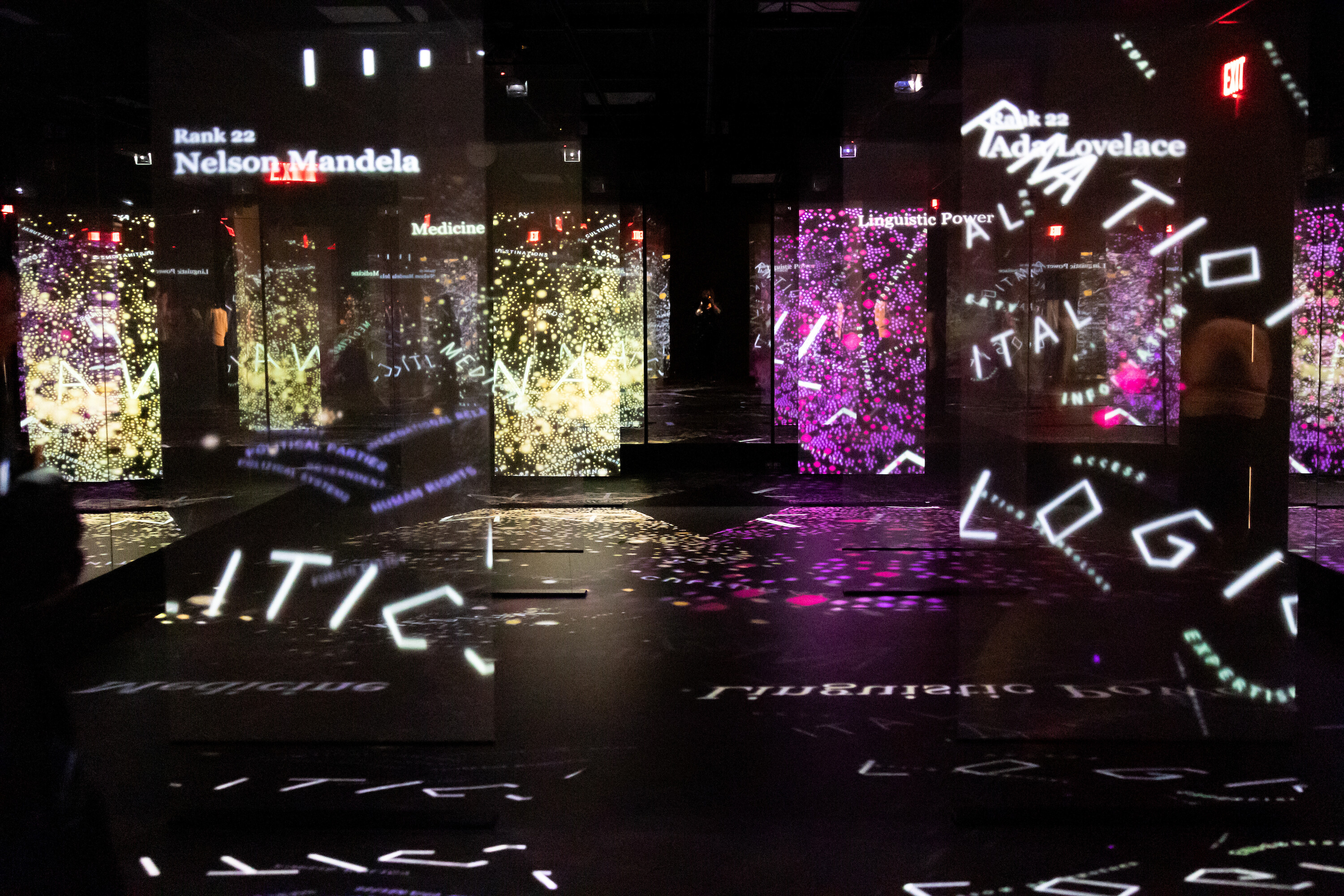
My project Artificial Worldviews investigates how systems like ChatGPT structure knowledge. I conducted thousands of algorithmic conversations and created maps that make these structures visible. I’m interested in how we can render such systems readable, even though they are often described as “black boxes.” Currently, I am working on a project about data brokers—companies that trade our data in milliseconds without us noticing. With my work, I aim to make this invisible infrastructure visible and to expose questionable practices.

Interview by Sophia Stenzel.
Images by Kim Albrecht.

Further Links:
kimalbrecht.com
www.databased.design

Edit
University of the Arts